As the party keeps going, how important are all-time highs?
Key Observations
- Q3 is on track to deliver a fourth straight quarter of double-digit earnings growth. The Fed’s October rate cut added momentum to already strong 2025 performance.
- The 0.25% cut was expected, but the tone surprised. Hawkish dissent and Powell’s remarks shifted sentiment. Futures markets dropped from a 94% chance of a December cut to 69% post-meeting.
- Supportive macroeconomic conditions have propelled markets to new all-time highs. To understand the implications, consider the following context:
- Headline index price offers limited insight. If a headline touts an ‘all-time high’, move on to something more insightful.
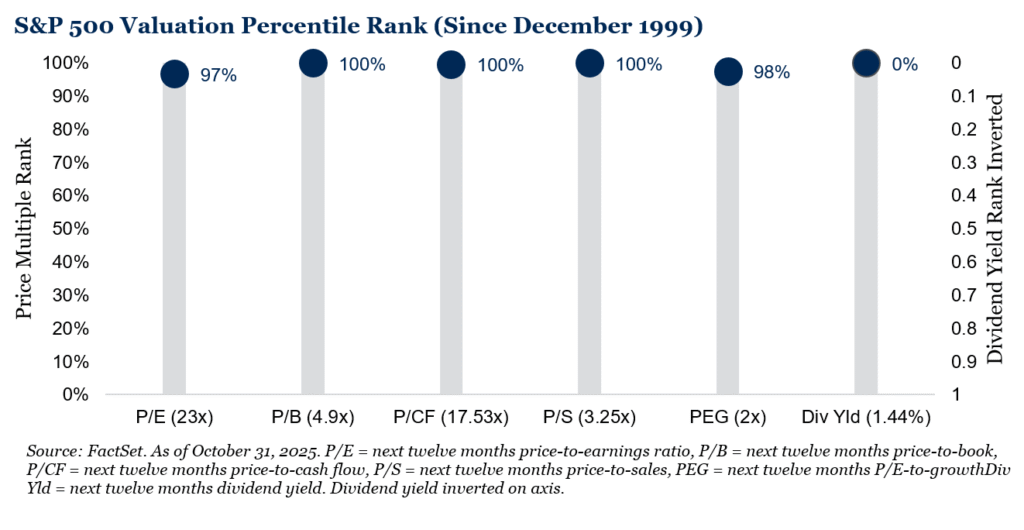
- Valuations are more telling. While they don’t predict 2026 outcomes, elevated valuations warrant attention and may signal future volatility.
- Record concentration within the S&P 500 intensifies existing dynamics. A narrow leadership amplifies both risk and opportunity, making diversification and selectivity more critical.
Market Recap
The rally continued in October, fueled by persistent optimism about artificial intelligence, ongoing rate cuts from the Federal Reserve and robust third-quarter earnings. As of October 31, 64% of S&P 500 companies had reported earnings, with blended earnings growth at 10.7%1. If the quarter closes above 10%, it will mark the fourth consecutive quarter of double-digit earnings growth.
U.S. equities moved higher, with the S&P 500 gaining 2.3%. Technology stocks led the advance, propelled by robust earnings and sustained enthusiasm for AI. This powerful tailwind aided in growth stocks outperforming value stocks during the month. Small caps rose 1.8%, though their pace moderated after a strong third quarter.
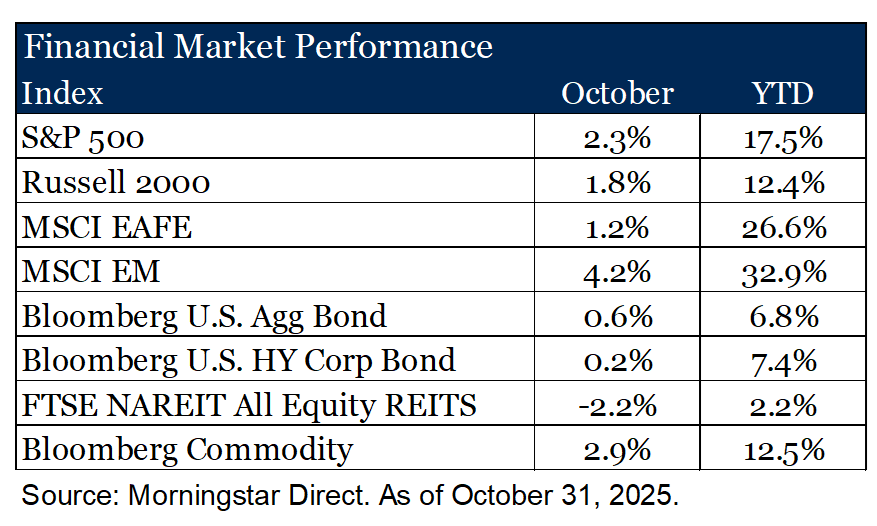
Overseas, developed markets posted modest gains, constrained by sluggish growth in Europe and Japan. Emerging markets outperformed, buoyed by China’s targeted stimulus and a temporary easing of U.S.-China trade tensions. South Korea stood out, adding to its nearly 100% year-to-date gain. Investor excitement around Samsung Electronics, the country’s largest publicly traded company, played a key role in driving returns.
Bond markets rallied as yields declined, reflecting continued central bank easing. Although the 0.25% rate cut was widely anticipated, hawkish dissent and Chairman Powell’s remarks on the balance of risks caught investors off guard. Futures markets, which had priced in a 94% probability of a December cut before the meeting, dropped to 67% after2.
Commodities delivered mixed results. Gold, while up for the month, experienced its largest single-day decline in several years, losing some of its shine amid shifting rate expectations.
Overall, asset prices moved higher, fueled by continued optimism. This brings us to the topic of “highs”. Markets have been hitting quite a few of them lately. Headlines celebrate record-breaking numbers, but it is worth asking: what do these “highs” actually mean? In the sections that follow, we will explore three new all-time highs; price, valuation and concentration, to better understand the implications for investors.
Price
Financial media loves a milestone. “S&P Hits Record High!”, “Dow Tops 47,000!”. These headlines grab attention, but they rarely offer insight. Price alone is just a number. It is like hearing someone has paid $40 for dinner without knowing what they ordered. If it was grilled cheese and tap water, that is steep! If it was a prime steak and a great glass of wine, maybe it was a bargain. The same logic applies to markets. Price tells us what something costs, but not what it is worth. And historically, new highs in price alone have shown little predictive power. They’re psychological markers, not reliable signals.
Valuation
Valuation, on the other hand, measures what we receive for the price we pay. In equity markets, that’s earnings per share. When we buy a stock, we are purchasing a claim on future earnings, or the economic value a business generates. If those earnings grow, the price may follow, and we are rewarded through higher returns.
Low valuations often reflect modest expectations, which can create upside. High valuations, on the other hand, imply optimism. That optimism raises the bar and risk the investment fails to deliver. Valuation is not a perfect predictor, however. The biggest nuance is time. In the short term, valuation has little influence on how a stock trades next month, quarter or year. However, extend the horizon, and the picture changes. Over longer periods, valuation becomes far more meaningful to future outcomes.
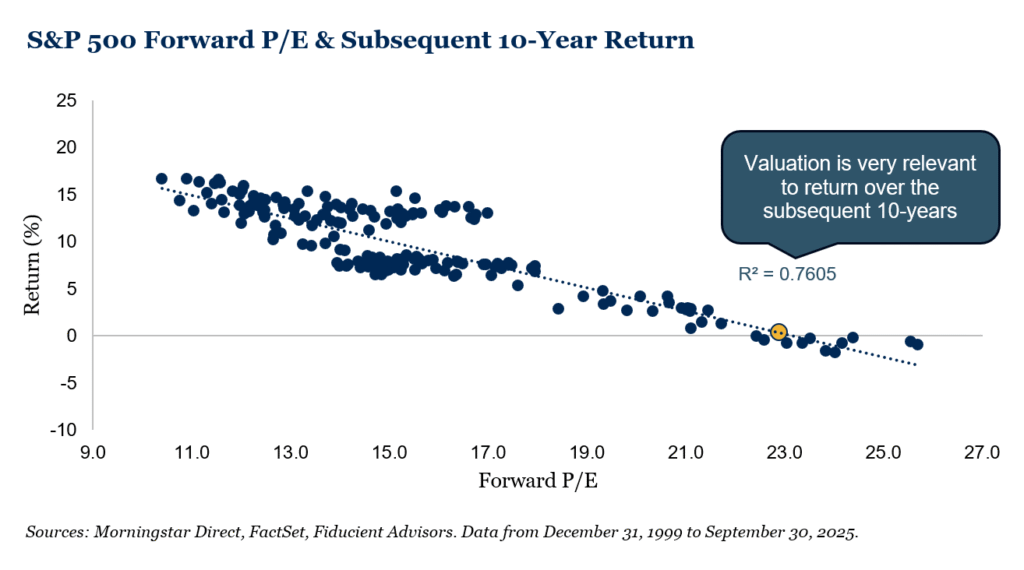
Today, markets are expensive by nearly every measure. What does that mean for 2026? As evidenced above, not much. But for long-term investors, it matters a great deal. High valuations call for deliberate risk management, thoughtful diversification, and a clear plan for what to do if prices fall.
Concentration
The S&P 500 is also reaching record levels of concentration. As of October 31, 2025, the top 10 stocks account for 40.2%1 of the index, an all-time high. Unlike price or valuation, concentration does not stand alone, it amplifies what is already there. Think of it like leverage. When things go well, it boosts returns. When they go poorly, it magnifies losses.
Since 1991, markets with above average concentration saw intra-year max drawdowns that were over 5% larger than below average concentration (-7.7% vs -12.9%)1. This concept is perhaps best exemplified by a sports team. A team built around one star player might shine, but it is less resilient than one with a deep bench. Today, AI is that star player, driving a handful of stocks to new highs. But the more concentrated the market becomes, the more fragile it may be. As concentration climbs, it intensifies the risks tied to high valuations. That’s why we believe it is more important than ever to stay intentional; manage risk, diversify wisely and prepare for what comes next.
1.FactSet as of October, 31 2025
2.CME Fed Watch Tool as of November 3, 2025
Listen and subscribe to our Wealthy Behavior podcast to stay up-to-date on the latest market, economic and investment news that affects your wealth. If you like what you hear, please leave our show a review on Apple Podcasts or Spotify so we can reach more people like you!