

Unlocking Opportunity Beyond Public Markets
At Heritage Financial, we believe that broad market coverage across public and private markets is key to building opportunistic, diversified investment portfolios that can help qualified clients reach their goals.
Why Consider Private Investments?
Private investments may offer attractive return potential, enhance diversification, and strengthen risk management when used alongside traditional stock and bond holdings.
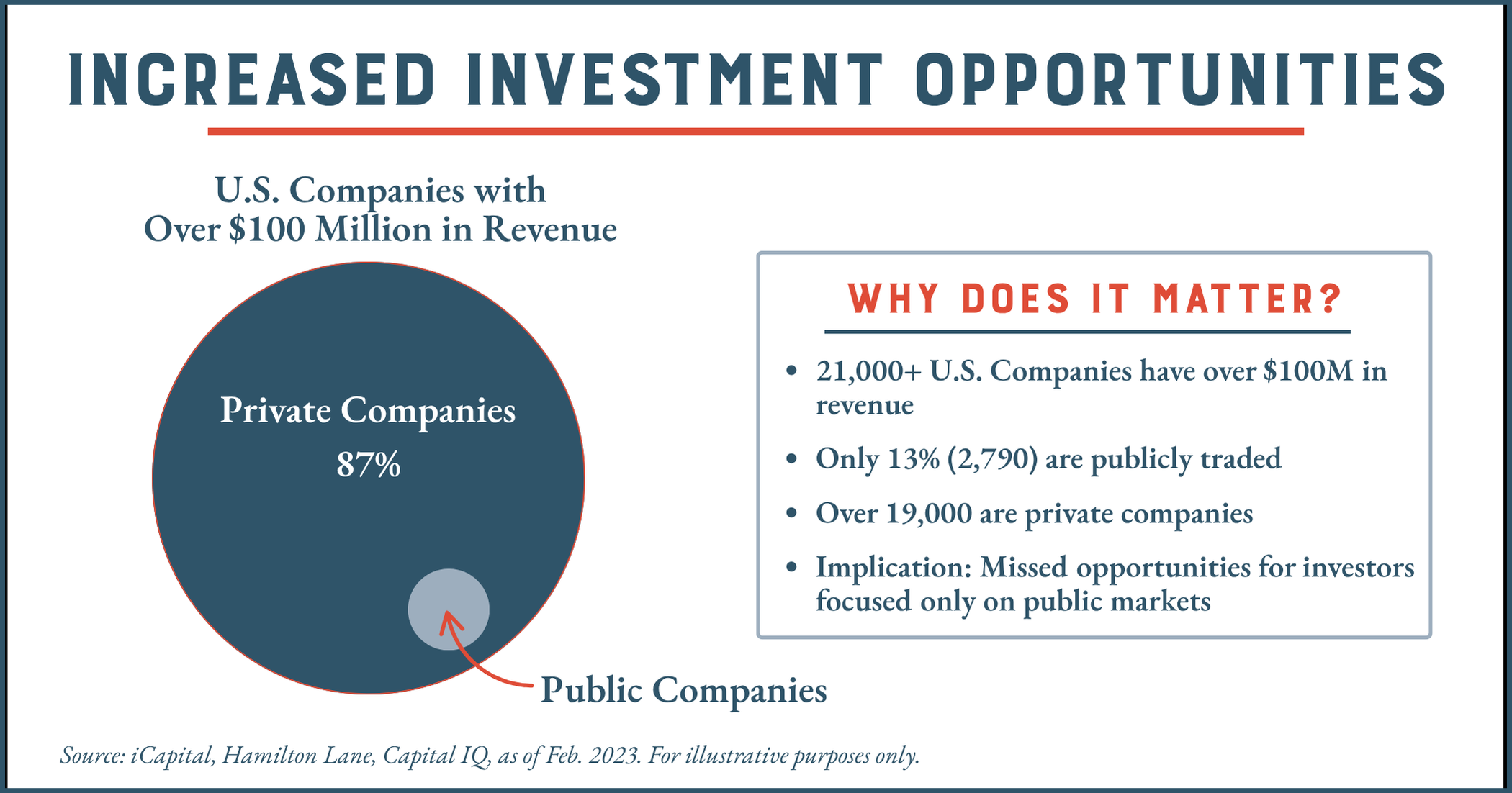
Publicly traded companies represent only a small fraction of businesses
As regulatory and reporting burdens have grown, the number of publicly traded companies have declined—making private markets an increasingly important and often overlooked investment opportunity.
Of the 21,000+ U.S. companies generating over $100M in revenue, only13% are publicly traded—meaning the majority of investment opportunities are in private companies.
Our Private-Market Investment Approach
With over 15 years of experience in private markets, our investment team brings deep expertise to manager research and due diligence to curate private investment opportunities.
Manager Experience: Demonstrated sector expertise and a strong track record of success across various market environments.
Growth Strategy: Demonstrated ability to drive efficient operations and a clear plan for sustainable, long-term growth.
High General Partner Commitment: A meaningful financial commitment from managers, indicating alignment of interests with investors.
Attractive Fees: A competitive and transparent fee structure, with performance-based hurdles that align with investor outcomes.
Right-Sized Funds: A disciplined approach to capital raising and deployment to avoid asset bloat and support long-term performance.
Effective manager selection is critical to achieving strong returns in alternative investments
In private markets, the performance gap between top and bottom quartile managers is significantly wider than in public markets—making the selection of a skilled manager even more important.
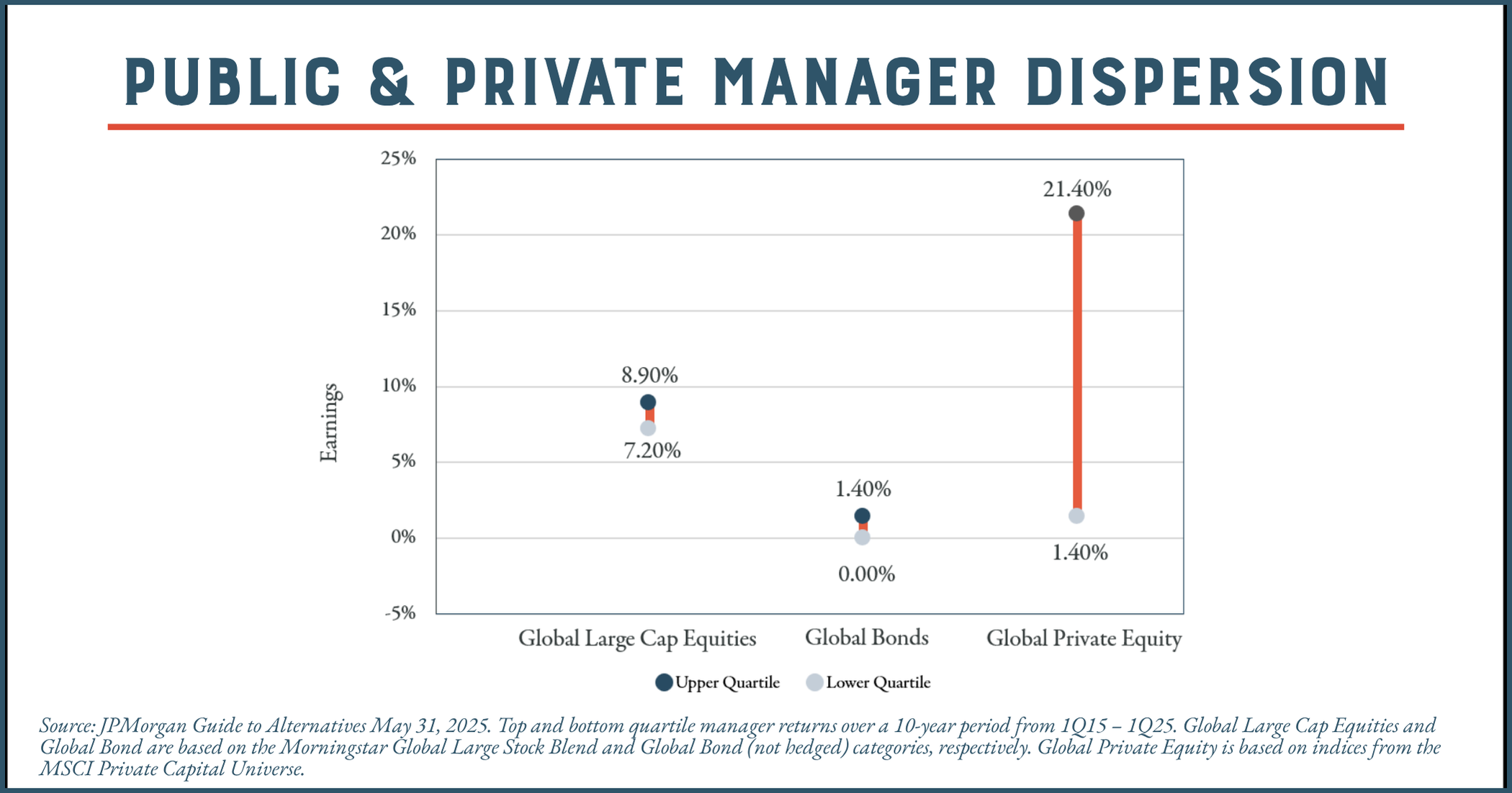
As the chart above illustrates, top-quartile private equity managers returned over 21%, compared to 1.4% for bottom-quartile managers.
This vast return dispersion underscores the importance of manager selection to unlock the return-enhancing potential of alternatives.
How to Invest in Private Investments
Private investments can play a valuable role in a well-diversified portfolio—especially for investors focused on long-term growth and comfortable with reduced liquidity.
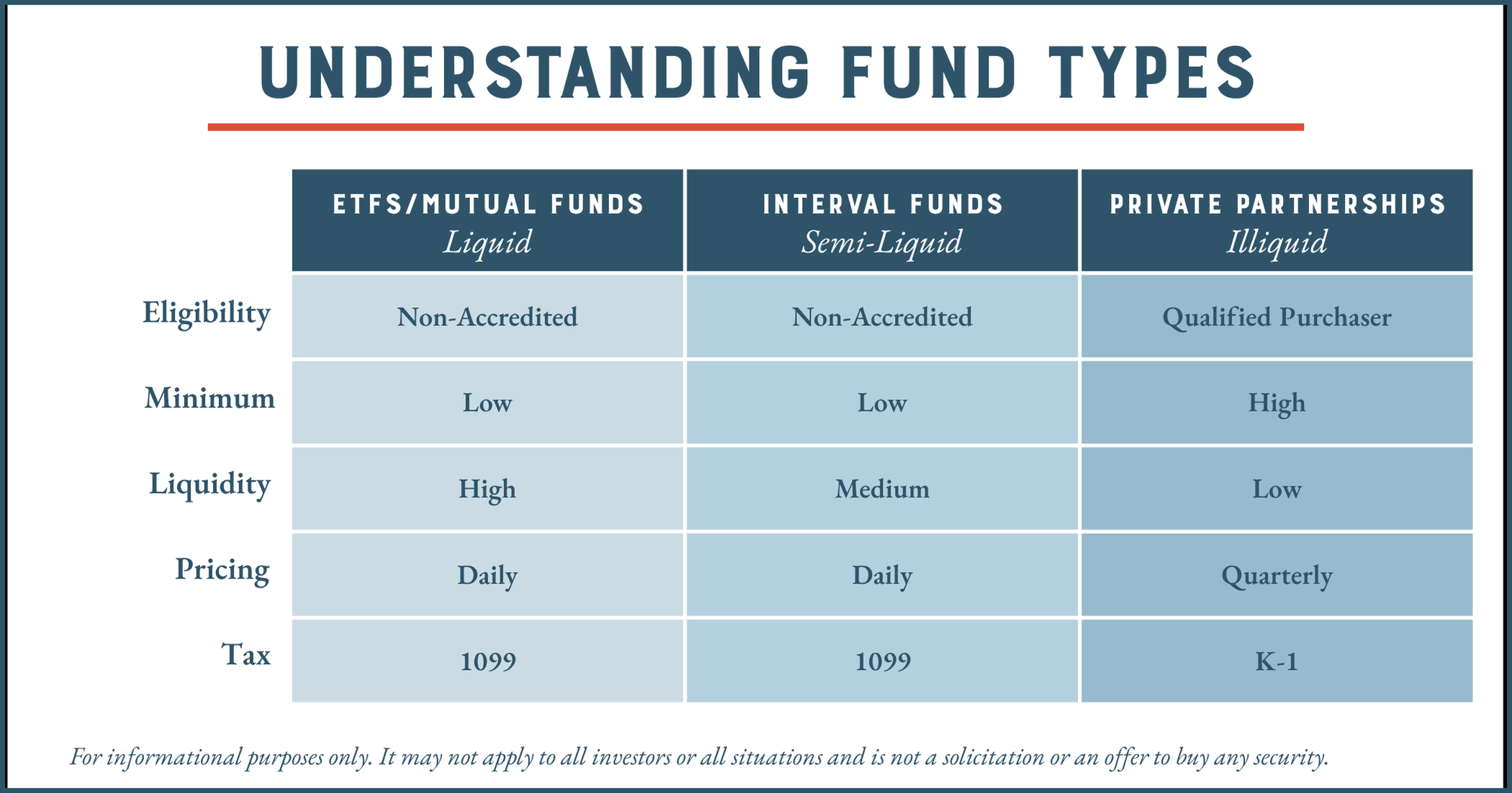
That said, private investments differ from traditional public market investments in that they often involve:
Longer investment time horizons
Higher minimum investment requirements
Unique risks and complexity
Are private investments right for you?
Private Investment FAQs
Publicly traded companies represent only a small fraction of businesses in the U.S. Incorporating private equity and other alternative investments opens access to new markets and untapped sources of potential return.
Private equity refers to ownership in companies that are not publicly traded on stock exchanges. Investors allocate capital to private equity managers, who acquire ownership stakes in private companies to support growth, drive operational improvements, and ultimately position the business for a sale or public offering. These investments are typically made through illiquid funds with lock-up periods of 10 years or more.
Private credit is direct, non-bank lending, provided to companies by private credit funds. Unlike traditional public debt, private credit arrangements are privately negotiated, offering more flexible terms to borrowers and attractive yield to investors.
Private equity refers to ownership stakes in companies that are not publicly traded. These companies can range from early-stage startups to mature, established businesses.
Venture capital (VC) is a subset of private equity that focuses on investing in early-stage companies, often pre-revenue or in their initial growth phases. VC investing generally involves higher risk because early-stage companies have a greater chance of failure or default.
Heritage Financial invests across a diverse type of fund structures, encompassing growth equity, mature buyouts, private credit, and real estate for clients.
In general, private equity tends to appear more stable during market downturns compared to publicly traded investments. Private equity holdings are typically valued quarterly. This less frequent pricing can help smooth out short-term market volatility; however, it also requires investors to maintain a long-term perspective and accept the illiquidity inherent in these investments.
Private equity can be a valuable component of a well-diversified portfolio, offering the potential for enhanced returns over time. However, like all investments, it carries risks—including during periods of economic stress—so careful selection and a long-term mindset are essential.
Heritage Financial has over 15 years of experience investing in private equity for our clients. What sets us apart is the depth of our due diligence process, the strength of our manager relationships, and our commitment to building diversified portfolios designed to perform across market cycles.
Our seasoned investment team conducts rigorous, ongoing due diligence to construct portfolios that are thoughtfully diversified by vintage year, strategy, and management team, helping to manage risk and enhance long-term return potential.
Private investments can be a valuable part of a well-diversified portfolio, particularly for investors seeking long-term growth and comfortable with less liquidity. It offers access to opportunities not available in public markets and may enhance overall return potential when thoughtfully integrated into a broader investment strategy.
However, private investments typically come with longer time horizons, higher minimum investment requirements, and unique risks. It’s important to carefully consider how these factors align with your financial goals, liquidity needs, and overall risk tolerance. At Heritage Financial, we will help evaluate whether private investments fit within your overall wealth plan and investment objectives. Let’s Talk.
PERSONALIZED WEALTH MANAGEMENT FOR BUSY, SUCCESSFUL PEOPLE
To get the ball rolling, send an email to hfsletstalk@heritagefinancial.net. Or, if you prefer, you can fill out this simple form.
What Our Clients Say
We feel very fortunate that we chose Heritage to be our financial managers. We know our savings are in good hands.
Kathy & Gary , Massachusetts
Over the years that I have been a client at Heritage, they have done a superb job of listening to my financial goals, and helping me achieve them. Thanks to them, and all things being equal, my retirement is and will be calm, financially sound, and will allow me to remain as independent as I wish. I value their insight, respect their continuing research, and appreciate that they continuously study to remain informed and current about the markets and the financial future we can all look forward to.
Sue , Massachusetts
Mary and I have long thought that one of the best things we have done is to use Heritage Financial to take care of our financial affairs. In that regard, we feel Heritage Financial is doing an excellent job and quite frankly, we sleep well at night without any money worries. But more than that, we have met very nice, friendly, professional people at Heritage. Mary and I value these relationships very highly. The service that you both provided me today is deeply appreciated and more “frosting on the cake”.
Heritage Clients , Massachusetts
Our experience with Heritage Financial services, has been nothing short of admirable. We have been with Heritage Financial for a long period of time, in which we’ve developed a strong and lasting relationship and friendship with many of the wealth advisors there. The advisors have been kind, honest, trusting and compassionate. Their advice has helped us make important financial decisions. We have recommended Heritage Financial to many of our friends, and family, and we will continue to recommend them.
Heritage Clients , Massachusetts
Peace of mind and a feeling of security is what all of us wish for as each year flies by during these uncertain times. I wish I had not waited until 2019 before enlisting the help of HFS, but better late than never!
The team at HFS is approachable, accessible, professional and they can explain even the most complex financial topics in laymen terms. The HFS team practices the perfect blend of the science as well as art of financial planning. I thank them for taking me and my family on as clients!
From a grateful client and her entire family , Massachusetts
This testimonial has been given by a current client of Heritage Financial Services. No compensation was provided for this testimonial.
Awards & Recognition
Selection criteria used to award each of these recognitions is available by clicking on the award logo. Heritage paid for the right to use Barron's and Forbes logos and to access premium website features.